
Simpson County Parole Differences
Parole and probation both allow a person to live outside a jail or prison, but they start in different ways. Parole is release from imprisonment under conditions after action within Kentucky's correctional process. Probation is a community sentence ordered by a court. A person may also leave state custody through mandatory reentry, a statutory form of supervised release that is not discretionary parole. None of these terms means the whole sentence has ended.
The Kentucky Department of Corrections Division of Probation and Parole administers community supervision in Simpson County. The Kentucky Parole Board handles parole decisions for eligible state prisoners, including some sentenced felons housed in county jails. A person who bonds out of Simpson County Detention Center, has a misdemeanor case, or completes a short local sentence is not automatically a DOC supervision case.
| Record type | How it begins | Best public check |
|---|---|---|
| Parole | Conditional release from imprisonment | KOOL status, location, and parole table |
| Probation | Court-ordered community sentence | KOOL plus the Simpson court case |
| Mandatory reentry | Statutory supervised release | KOOL, DOC records, and VINE event |
| Final discharge | Sentence and supervision obligations end | DOC or supervising-agency record |
- Physical release
- The person leaves a jail or prison building.
- Discharge
- The legal sentence or supervision obligation ends.
- Absconder
- A person reported out of compliance with supervision or location duties.
- Transfer
- Custody moves to another agency; community release has not been shown.
Verify Simpson County Probation
Kentucky Offender Online Lookup, known as KOOL, is the main public route for a DOC-supervised person. Search with an exact name or DOC/PID identifier. The form also supports Supervision Status, County of Supervision, location, aliases, conviction county, and other filters. Identity comes first. Similar names should never be merged without a matching identifier or date of birth.
- Search KOOL by exact name, alias, or DOC/PID number.
- Narrow with Supervision Status and Simpson as County of Supervision when appropriate.
- Open the match and read current status and current location before any date.
- Review the parole information table and conviction details for context.
- Contact the Simpson satellite when a District 2 label or status is ambiguous.
- Check the court docket or VINE event if physical release itself must be proved.
A community Probation and Parole district location is not the same as an institution. It may show that the person is out of prison but still supervised. An institution location points toward confinement. KOOL says entries and accuracy work occur daily, yet information newer than 120 days may not be final. For that reason, a public result is a strong lead, not a substitute for the agency's own clarification.
The Simpson jail's official contact list provides a useful local verification path.
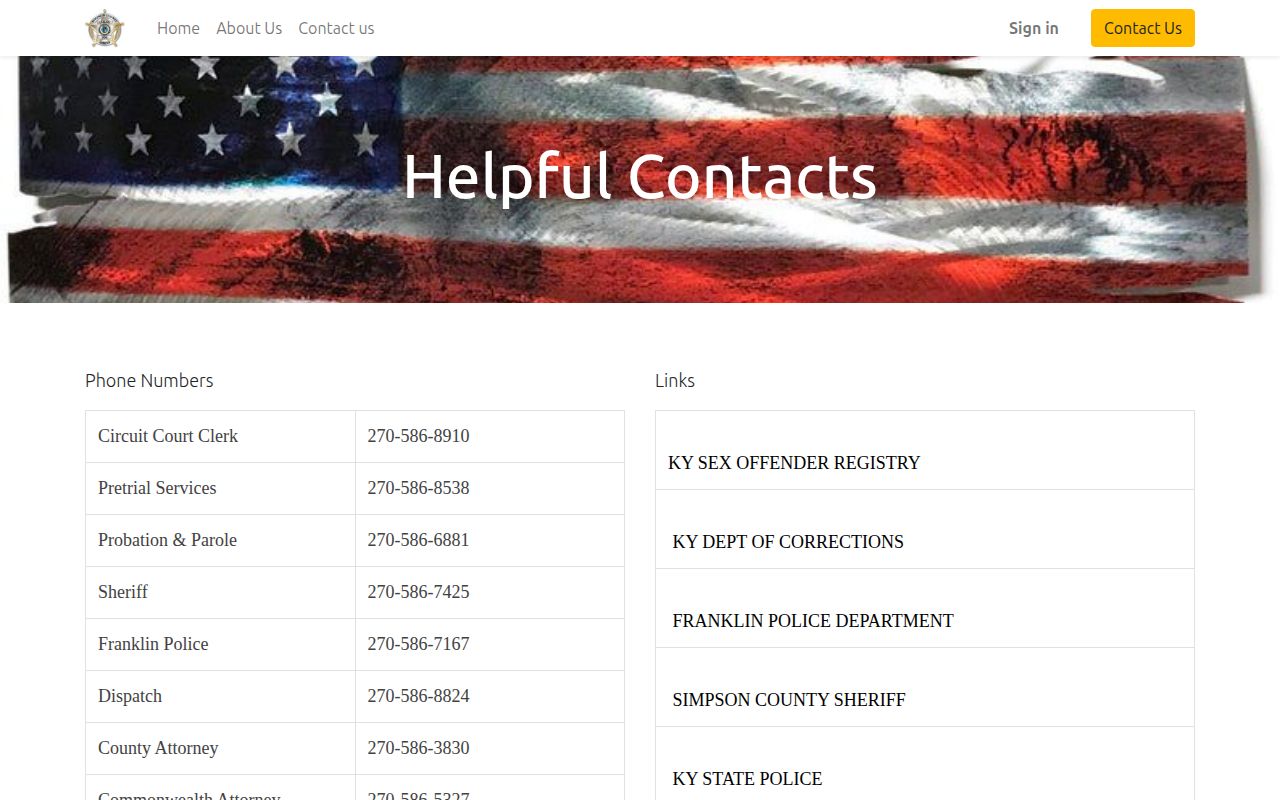
The captured contact page reinforces that jail, court, DOC, and supervision questions belong with different offices.
Simpson County Supervision Office
Simpson County belongs to Kentucky DOC Probation and Parole District 2. The local satellite provides a direct route for public questions that KOOL cannot resolve. Staff may confirm or explain public information, but confidential case details may remain unavailable. Call with a full name and DOC/PID number if known, and state which public label needs clarification.
District 2 Simpson Satellite
1004 Brookhaven Road
Franklin, KY 42134
Phone: 270-586-6881
Fax: 270-586-3742
District headquarters is at 512 S. Clay Street, Hopkinsville, KY 42240, with phone 270-889-6530. District 2 also covers Allen, Butler, Christian, Edmonson, Hopkins, Logan, and Todd counties. The local satellite is usually the more focused start for a Simpson supervision label. If the question instead concerns whether a person physically left Simpson County Detention Center, request the jail movement or release transaction.
Simpson County Absconder Status
An absconded flag reports a supervision or location-compliance problem. It does not, by itself, say the person is now in jail. Nor does it erase the fact that the person was once physically released. KOOL can display an absconded warning, while a court docket may show a later warrant, violation filing, or revocation order. Those are related facts, but they are not interchangeable.
Conditions can include reporting, approved residence, travel limits, treatment, fees, or other case-specific duties. Public sources do not establish the exact conditions for every person. A violation allegation may lead to a warrant or revocation process, yet custody should still be checked through the agency that might hold the person. Kentucky VINE can report a later custody event from a participating agency. The Kentucky VINELink search must be read by reporting agency because release from one agency does not rule out another hold.
Note: An absconder warning is a supervision status, not a reliable statement of current jail location.
Simpson Release Program Credits
Simpson County Detention Center's SCORE program supplies local reentry context. The official program page describes individual case plans, classes, community service, and New Directions. It also lists DOC awards of 90 days for several qualifying educational or treatment programs and 60 days for Thinking for Good. Those published figures describe possible awards for qualified residents, not a promise that a named person will leave on a set date.
Actual sentence credit depends on Kentucky law, DOC calculation, eligibility, completion records, sentence structure, and any forfeiture or restoration. Program work can support reentry without proving parole, probation, or discharge. A county resident who completed a class could still be confined, transferred, released under supervision, or later discharged. KOOL and the responsible office remain the correct status sources.
The official SCORE page shows the local program framework.

This local program material should be paired with a DOC status record, not treated as release proof.
Simpson Release ID Questions
Kentucky has announced an identification initiative for people released from state custody. That state-prison policy does not prove that Simpson County Detention Center issues identification to people leaving the county jail. Research also found a 2026 proposal about county and local felony releases, but the source reviewed showed it as pending rather than enacted. The distinction matters when planning for a release.
Simpson publishes no clear procedure for return of property, release identification, or correction of a mistaken jail record. Ask the detention center for its current written procedure instead of assuming state-prison rules apply. The jail can be reached at 270-586-5351 or info@simpsoncojail.org. A request should identify the confinement and ask what record or process governs the specific issue. Questions about a state prison release should go to DOC; questions about supervision after that release should go to District 2.
Ending Simpson County Supervision
Release from a cell and final discharge are separate milestones. Parole or probation can end after the required term and conditions are satisfied, but the public record must support that conclusion. An old proposed release date, a community district location, or the absence of a fresh entry does not prove final discharge. Seek the relevant DOC or supervision record when the end date matters.
The Kentucky Parole Board's hearing eligibility, a scheduled hearing, and a recommendation are also distinct. A recommendation may produce a proposed date, yet later KOOL status, DOC release data, VINE, and Probation and Parole provide better evidence of actual movement. A Board denial does not rule out every later statutory release path. Mandatory reentry can operate under a separate statute and set of exceptions.
For a broad custody history, the Simpson County released-inmate search and record path explains how the jail transaction, court order, and agency status fit together. Final discharge should be described only when the responsible record says the sentence or supervision obligation ended.
Public Record Search
Sponsored Results